

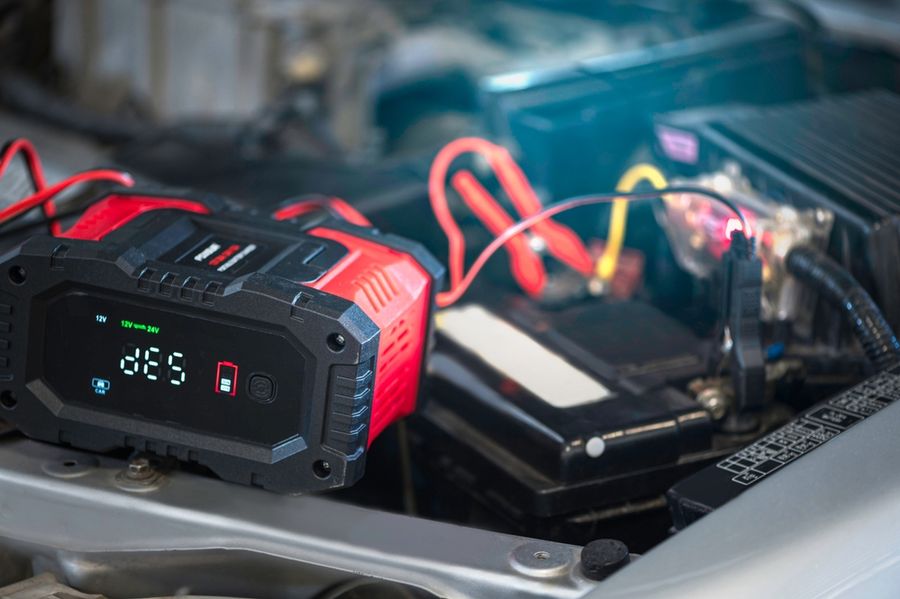
A car parked for weeks can lose battery charge even though the engine never starts. Alarms, computers, clocks, and other electronics keep drawing small amounts of power while the vehicle sits. Over time, that steady drain may leave the battery too weak to turn the engine over when needed. A battery maintainer supplies a controlled charge during storage, helping preserve battery health and reduce the risk of an unexpected no-start.
How These Six Devices Compare on Setup, Safety, and Battery Type
Three factors separate one maintainer from another: how it matches a battery's chemistry (lead-acid versus lithium), how it behaves once the battery reaches full charge, and how much output it delivers. Parasitic draw from a car's alarm, computer, and clock can drain a battery faster than most drivers expect, which is why a car parked for even a few days between drives benefits from a periodic charge.
Battery Maintainer Options at a Glance
|
Option |
Suitable For |
Typical Cost |
|---|---|---|
|
Battery Tender Junior |
Motorcycles, small batteries |
|
|
Battery Tender Plus |
Long-term single-vehicle storage |
|
|
CTEK CT5 Time To Go |
Mixed AGM and flooded batteries |
|
|
NOCO GENIUS1 |
Tight spaces, small engines |
|
|
NOCO GENIUS5 |
Faster top-off, mid-size batteries |
|
|
NOCO GENIUS10 |
Multiple vehicles, larger batteries |
Battery Maintainer Options for Cars That Sit Idle
These six units cover the range most drivers actually encounter, from a motorcycle stored over winter to a truck with a large battery that sees infrequent use. For a standard car battery, a charger in roughly the 1 to 2 amp range is often the right fit for maintenance duty, while smaller batteries such as those in motorcycles or lawn equipment typically call for a lower output.
Battery Tender Junior: Suitable for Motorcycles and Small Batteries
The Battery Tender Junior is built around a small footprint and a lower output, which fits motorcycles, ATVs, and other powersport batteries rather than a full-size car battery. Its four-step charging program is simple to set up and does not require app pairing or manual mode selection.
Pros:
- Compact size fits tight spaces
- Simple plug-and-forget operation
- Long track record with powersport owners
Cons:
- Lower output for small batteries only
- No digital display or readout
Suitable for: a rider maintaining a motorcycle or ATV battery through a single off-season.
Battery Tender Plus: Suitable for Long-Term Single-Vehicle Storage
The Battery Tender Plus runs a four-stage cycle, bulk, absorption, float, and pulse maintenance, and it has held that same basic design for years because it works reliably for extended storage. Rather than a constant trickle, it pulses current only when voltage dips below a set point, which limits water loss in the cells over many months connected.
Pros:
- Proven long-term reliability record
- Automatic pulse mode limits overcharging
- Works with standard flooded batteries
Cons:
- No lithium battery compatibility
- Single-battery use only
Suitable for: a classic car or seasonal vehicle parked for an entire winter.
CTEK CT5 Time To Go: Suitable for Mixed AGM and Flooded Batteries
The CTEK CT5 Time To Go adds a countdown display that estimates hours remaining until full charge, along with separate Normal, AGM, and Recond programs. The Recond mode targets stratified or deeply discharged flooded batteries specifically, which makes it useful in a household running more than one battery chemistry.
Pros:
- Separate AGM and Recond programs
- Countdown display shows time remaining
- Splash and dust resistant housing
Cons:
- Higher price than basic maintainers
- Recond mode unsuitable for lithium batteries
Suitable for: a garage with both a flooded battery and an AGM battery that need different charge programs.
NOCO GENIUS1: Suitable for Tight Spaces and Small Engines
The NOCO GENIUS1 is the smallest unit in the GENIUS lineup and covers 6V and 12V lead-acid and lithium batteries in one compact body. A thermal sensor adjusts output for ambient temperature, which matters for a maintainer left connected through a full winter or summer.
Pros:
- Small enough for tight engine bays
- Works on lead-acid and lithium
- Temperature-adjusted charging built in
Cons:
- Lower output means slower recovery
- Limited to smaller battery sizes
Suitable for: a lawn tractor, motorcycle, or small daily driver with limited under-hood clearance.
NOCO GENIUS5: Suitable for Faster Top-Off on Mid-Size Batteries
The NOCO GENIUS5 shares the same thermal compensation and multi-chemistry support as the GENIUS1 but delivers more output, which shortens the time needed to bring a partially drained battery back up. That extra output still stays within a safe range for long-term maintenance rather than a fast charge cycle.
Pros:
- Faster recovery than 1A units
- Multi-chemistry, including lithium support
- Sturdy clamps and longer cables
Cons:
- Bulkier than the smallest models
- Overkill for very small batteries
Suitable for: a mid-size sedan or SUV battery that needs occasional faster attention between long idle stretches.
NOCO GENIUS10: Suitable for Multiple Vehicles or Larger Batteries
The NOCO GENIUS10 steps up to a higher output designed for larger batteries, including trucks, SUVs, and marine or RV batteries, while keeping the same automatic shutoff and multi-chemistry support as the smaller GENIUS models. A dedicated recovery mode targets batteries that have dropped to very low voltage.
Pros:
- Handles larger truck and RV batteries
- Recovery mode for deeply discharged units
- Six supported battery chemistries
Cons:
- Larger and heavier than 1A or 5A units
- More output than a small battery needs
Suitable for: a household rotating maintenance across a truck, a boat, and a stored second vehicle.
How the Options Differ
Each of these six units solves a slightly different version of the same problem. The Battery Tender models favor simplicity and a long service record, while the CTEK CT5 adds a countdown display and a dedicated reconditioning mode for flooded batteries.
The NOCO GENIUS line scales output across three sizes while keeping the same lithium compatibility and thermal protection throughout. Matching output and chemistry support to the specific battery in question matters more than any single feature on its own.
What to Ask Before You Pick a Maintainer
Start with the battery chemistry. A standard flooded lead-acid battery works with any of these six units, but a lithium (LiFePO4) battery needs a maintainer that explicitly lists lithium support, which rules out the Battery Tender models here.
Next, think about how many vehicles need coverage. A single motorcycle or small car is well served by a 1A-class unit, while a household maintaining a truck, a boat, or more than one seasonal vehicle benefits from the higher output and chemistry range of a 10A-class unit.
Finally, consider climate. A maintainer left connected through a hot summer or a freezing winter should include temperature compensation, since a fixed charge voltage that ignores ambient temperature can slowly overcharge or undercharge a battery left connected for months.
Frequently Asked Questions
Q: Can a battery maintainer stay connected all winter without damaging the battery? Yes, as long as the unit has an automatic float or maintenance mode that stops delivering current once the battery is full. A basic, unregulated trickle charger without that feature can overcharge a battery over many weeks.
Q: Do I need a different maintainer for a lithium battery than for a standard lead-acid battery? Lithium (LiFePO4) batteries need a maintainer that specifically lists lithium compatibility, since the charge profile differs from lead-acid chemistry. Using a lead-acid-only unit on a lithium battery can leave it undercharged or trigger its internal protection circuit.
Q: How much output do I actually need for a car that just sits between drives? For routine maintenance rather than reviving a dead battery, a charger in roughly the 1 to 2 amp range is generally enough for a standard passenger car battery. Larger batteries, such as those in trucks or RVs, typically benefit from a higher-output unit.
We created this article in conjunction with AI technology, then made sure it was fact-checked and edited by a TopicTangent editor.