

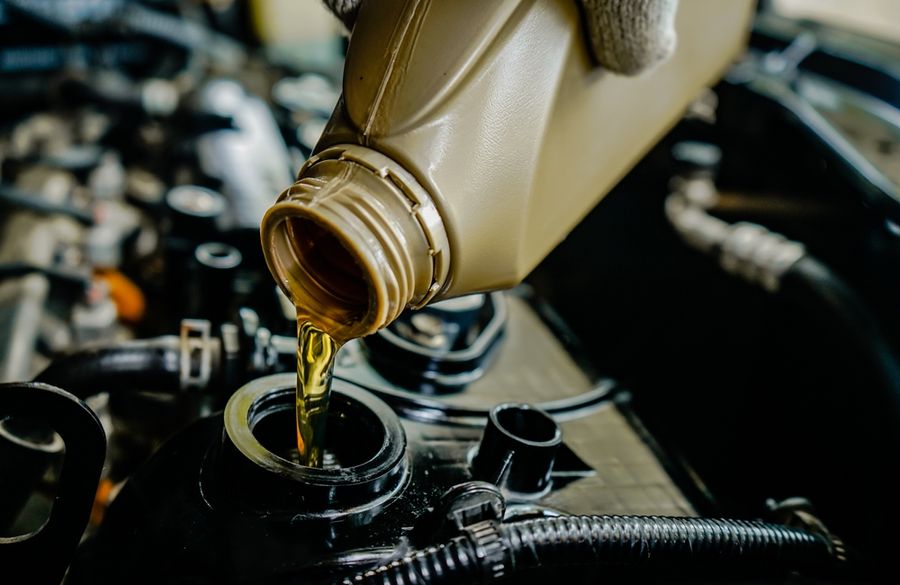
Motor oil is one of the most important fluids in any vehicle, yet many drivers think of it only in terms of routine oil changes. In reality, oil performs several critical jobs every time an engine runs, from reducing friction and managing heat to carrying away contaminants and protecting internal components from corrosion. Modern engines operate with tighter tolerances and greater complexity than ever before, making proper lubrication even more essential. Understanding what motor oil actually does helps explain why maintenance schedules matter so much.
The Short Version
Motor oil lubricates moving parts, carries heat away from areas coolant cannot reach, suspends and removes combustion byproducts, and protects metal surfaces from corrosion. It does all four things at once, every time the engine runs. Oil degrades over time and mileage, losing its ability to do each of these jobs effectively. Modern engines with smaller tolerances and more complex systems are less forgiving of degraded oil than older designs. Following your manufacturer's recommended change interval, not a generic rule, is the single most reliable way to protect your engine.
How Motor Oil Actually Works
When you start your engine, hundreds of metal surfaces begin moving against each other at high speed. Without oil, those surfaces would contact directly, generate enormous heat from friction, and weld themselves together within seconds. Oil creates a thin film between moving parts, a hydrodynamic layer that keeps metal from touching metal. This is the lubrication function, and it is what most people picture when they think about oil's purpose.
But oil also acts as a secondary cooling system. The main coolant loop handles the combustion chamber and cylinder walls. Oil handles the crankshaft, rod bearings, camshafts, and turbocharger internals, places that coolant never reaches. In a turbocharged engine, oil circulates through the turbo bearing housing to manage temperatures that can exceed 400 degrees Fahrenheit. This is why letting a turbocharged engine idle for a minute before shutting it off, and again briefly after a cold start, protects one of the most expensive components on the vehicle.
Oil also functions as the engine's cleaning system. Combustion is not perfectly clean. Tiny particles of carbon, unburned fuel, and metal wear debris circulate inside the engine constantly. Oil suspends these particles and carries them to the oil filter, which traps them before they can score bearing surfaces. This is why used oil turns dark: it is doing its job. An oil that has reached its service limit is carrying as many contaminants as it can hold and can no longer suspend new ones effectively.
The fourth job is corrosion protection. Engine oil contains additive packages that neutralize the acids produced during combustion and prevent moisture from attacking bare metal surfaces. As oil ages, these additives deplete even if the base oil itself has not broken down. An engine sitting with old oil, even one that has not been driven, can accumulate internal corrosion from condensation and acid buildup.
The 4 Factors That Determine How Long Your Oil Stays Effective
Factor 1: Viscosity Grade
Viscosity is the measure of how thick or thin an oil is, and it is expressed in grades like 5W-30 or 0W-20. The first number indicates cold-weather performance; the second indicates operating-temperature thickness. Modern engines are built to specific tolerances that assume a particular viscosity at operating temperature. Using an oil that is too thick starves narrow oil passages and puts strain on the oil pump. Using one that is too thin allows the film layer between bearing surfaces to collapse under load. Your owner's manual specifies the correct grade, and that specification is not a suggestion.
Factor 2: Driving Conditions
Oil degrades faster under what manufacturers call "severe service" conditions: frequent short trips (under 10 miles), stop-and-go traffic, towing, driving in extreme temperatures, or operating in dusty environments. Short trips are particularly hard on oil because the engine never fully warms up, allowing moisture and unburned fuel to accumulate in the crankcase without burning off. Drivers who primarily make short local trips should change oil closer to the lower end of their manufacturer's interval range, regardless of what the dashboard indicator says.
Factor 3: Engine Age and Design
Older engines with looser tolerances and simpler valve trains are somewhat more tolerant of oil that has passed its prime. Current engines are not. Direct-injection engines produce more soot than port-injection designs, which accelerates oil contamination. Variable valve timing systems use small oil passages and solenoids that can clog with degraded oil, causing fault codes and rough running. Turbocharged engines subject oil to higher heat than naturally aspirated ones, which breaks down base oil and additives more quickly.
Factor 4: Oil Type (Conventional vs. Synthetic)
Synthetic motor oil is manufactured to a more uniform molecular structure than conventional oil, which is refined from crude. That uniformity makes it more stable across a wider temperature range, more resistant to breakdown under heat, and more effective at maintaining viscosity during cold starts. Most vehicles built in the last ten to fifteen years are factory-filled with full synthetic and specified to use it. For those vehicles, using conventional oil to save a few dollars per change is a false economy that shortens drain intervals and reduces protection.
What Most People Get Wrong
"The oil change interval is 3,000 miles." The reality: this rule was accurate for conventional oil in engines built before roughly the mid-1990s. It has not been accurate for most modern vehicles for decades. Current manufacturer-recommended intervals for vehicles using full synthetic oil commonly range from 7,500 to 10,000 miles, and some extend to 15,000 miles under normal driving conditions. Following the 3,000-mile rule on a modern vehicle wastes money and oil without providing any additional protection.
"Dark oil means it needs to be changed immediately." The reality: oil turns dark because it is suspending combustion byproducts, which is exactly what it is supposed to do. Color alone is not a reliable indicator of oil condition. Fresh oil can darken within a few hundred miles in a direct-injection engine and still have thousands of miles of effective life remaining. The reliable indicators are mileage since the last change, time elapsed (oil should be changed at least once per year, even in low-mileage vehicles), and the oil life monitor if your vehicle has one.
"Using a higher viscosity oil gives older engines more protection." The reality: this advice was common for engines with worn bearings or high mileage, where thicker oil was thought to compensate for increased clearances. For most modern engines, using a viscosity grade heavier than what is specified creates more problems than it solves. It increases oil pump strain, slows circulation during cold starts, and can prevent oil from reaching tight tolerances in variable valve timing components. If you are concerned about an aging engine, the better move is more frequent changes with the correct grade, not a thicker grade at the same interval.
What This Means for You
We think the most common mistake drivers make is treating the synthetic-versus-conventional debate as the central question about motor oil, when the more important variable is whether they are following the right change interval for their actual driving conditions. Choosing full synthetic is the right call for most current vehicles. But synthetic oil changed on the wrong schedule, or ignored until a warning light appears, protects an engine far less than conventional oil changed consistently and on time.
The practical implication: pull out your owner's manual and find the actual recommended change interval for your vehicle. Then check whether your driving patterns qualify as severe service conditions. If you make mostly short trips, drive in heavy traffic, or tow regularly, use the shorter end of the recommended range. If your vehicle specifies synthetic and you have been using conventional to save money, the cost difference per change is usually under ten dollars and is not worth the tradeoff in protection or drain interval.
The other thing worth understanding is that the oil life monitor in most vehicles built after roughly 2010 is not a mileage counter. It is an algorithm that factors in engine temperature cycles, load, idle time, and cold starts to estimate actual oil degradation. It is a more accurate guide than any fixed mileage interval. If your vehicle has one, use it. If it does not, default to your owner's manual, not the sticker on your windshield from the last oil change shop.
Frequently Asked Questions
Can I mix synthetic and conventional oil in an emergency?
Yes, mixing them will not damage your engine. The two types are chemically compatible. The result will perform somewhere between the two in terms of temperature stability and change interval, so treat the mixed fill as conventional oil and plan a full change sooner than you otherwise would.
Why does my engine burn oil between changes?
Some oil consumption between changes is normal, particularly in high-mileage engines or performance engines that run at higher temperatures. Most manufacturers consider consumption of up to about one quart per 1,000 to 2,000 miles within acceptable limits, though the threshold varies by engine. Checking the dipstick every month or every other fuel fill-up is the only way to catch excessive consumption before it causes low-oil damage.
Does the brand of oil matter as much as the grade?
Brand matters less than meeting the correct specification. Look for oils that meet the API (American Petroleum Institute) service classification and the viscosity grade listed in your owner's manual. Many manufacturers also specify their own approval standards, particularly European brands. A lesser-known oil that meets the correct spec is more appropriate for your engine than a premium brand in the wrong viscosity grade.
What happens if I go significantly over my oil change interval?
Oil that has exceeded its service life loses its ability to suspend contaminants, neutralize acids, and maintain a stable film layer under load. Extended use causes sludge buildup, which can block oil passages and starve bearings or variable valve timing components. In severe cases, sludge damage is irreversible without an engine teardown. Going moderately over the interval once is unlikely to cause catastrophic damage in a healthy engine, but making it a habit accelerates wear in ways that compound over time.
The Bottom Line on Motor Oil
Pull your owner's manual from the glove box today and write down the recommended oil type, viscosity grade, and change interval for your vehicle. Knowing those three numbers costs nothing and is the single most useful piece of engine maintenance knowledge you can have before your next service appointment.
We created this article in conjunction with AI technology, then made sure it was fact-checked and edited by a TopicTangent editor.