

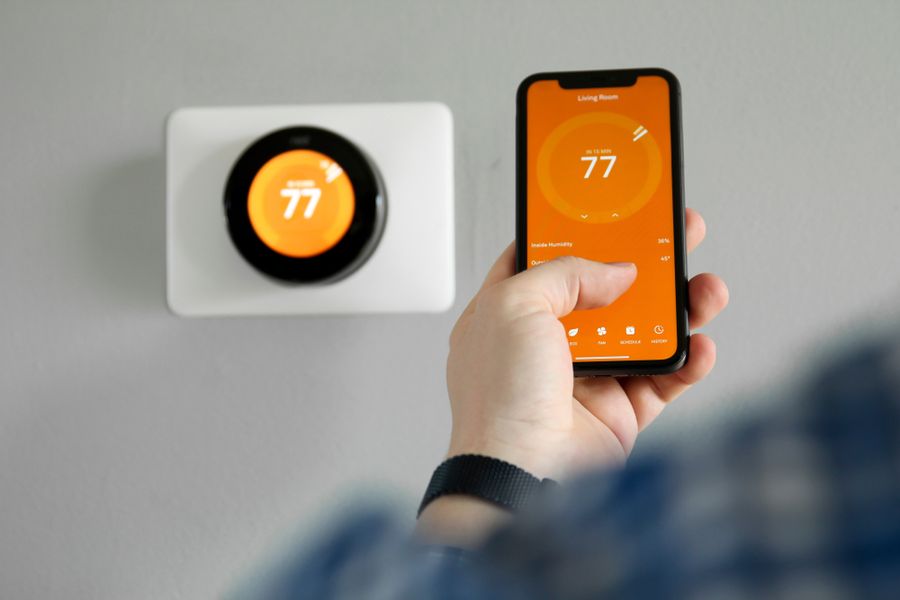
Heating and cooling account for a significant share of household energy expenses, which is why many homeowners look for ways to reduce waste without sacrificing comfort. Smart thermostats are often marketed as an easy upgrade that can lower utility bills automatically, but savings depend on more than simply replacing an old thermostat. Household routines, energy usage, HVAC compatibility, and installation costs all influence the real value of the investment. Understanding where a smart thermostat helps (and where it may not) can make the decision clearer.
What a Smart Thermostat Actually Is (and Isn't)
A smart thermostat connects to your home's Wi-Fi and adjusts heating and cooling automatically based on your schedule, habits, or location. Some models learn your preferences over time. Others use app-based scheduling. Most include remote control from your phone, monthly energy reports, and integration with voice assistants.
The common misconception is that "smart" means hands-off savings. It doesn't. A smart thermostat saves money by running your HVAC system less, mainly by pulling back the temperature when you're away or asleep. If you already do that manually, or if your schedule is irregular enough that no consistent pattern emerges, the financial gains are smaller than the marketing implies.
How to evaluate whether this upgrade is worth it:
We use three criteria in this order because they filter out the cases where smart thermostats underdeliver before you spend a dollar.
1. Schedule Variability
The more consistent your routine, the less a learning thermostat adds over a basic programmable model. If you leave at 8 a.m. and return at 6 p.m. most days, a cheap programmable thermostat handles that reliably. Smart thermostats earn their price in households where schedules shift week to week: remote workers who are home unpredictably, families with irregular hours, or anyone whose patterns resist a fixed program. Geofencing (adjusting temperature based on your phone's location) solves that problem in a way no manual schedule can replicate.
2. Baseline Energy Spend
A 10 to 15 percent reduction means very different things at different bill levels. If your annual heating and cooling cost is $600, saving 12 percent returns $72 a year. At that rate, a $250 thermostat takes more than three years to pay back. If your bill is $2,000 annually, that same percentage saves $240 per year, and the device pays for itself in roughly a year. Run your own number before buying.
3. HVAC Compatibility
This is the most overlooked factor and the most likely to add unexpected cost. Many smart thermostats require a common wire (C-wire) to power themselves continuously. Older systems often lack one. Adding a C-wire can cost $120 to $200 in labor or require an adapter kit. Heat pumps, multi-stage systems, and older boilers carry additional compatibility requirements. Check your system's specifications against the model's compatibility list before purchasing, not after the box is open.
How It Works in Practice
Most installations take 30 to 60 minutes for a homeowner comfortable with basic wiring. You shut off power to the HVAC system, photograph the existing wiring, disconnect the old thermostat, connect the new one to the matching terminals, and follow the app's setup steps. In reviewing installations across different home setups, the step that creates the most problems is identifying whether a C-wire exists and is connected at the furnace end, not just at the wall plate.
After installation, the first two to four weeks typically involve the thermostat learning your schedule and prompting you to confirm preferences. Once that period ends, most households interact with it occasionally: adjusting temperature remotely before arriving home, checking energy reports, or updating schedules by season.
The energy reporting feature is more useful than most people expect. Seeing exactly how many hours your system ran last week and comparing that to the previous month changes how you think about leaving the heat on when you leave the house.
Who Benefits Most
The homeowners who see the clearest return share one trait: their system was running more than it needed to, and a smart thermostat catches that waste automatically.
- A household where adults work variable hours and the heat runs through the afternoon, even when the house has been empty since morning
- A homeowner paying more than $150 a month in peak season with no existing programmable thermostat and no habit of manually adjusting before leaving
- Someone who frequently forgets to change the temperature before leaving and returns to a home that has been conditioning an empty space for hours
- A homeowner preparing to list their home who wants a low-cost efficiency upgrade that shows up on energy disclosures and appeals to cost-conscious buyers
The Real Downsides
Compatibility problems are the most common source of buyer's remorse. If your HVAC system is more than 20 years old, uses a proprietary control board, or requires a technician to assess before any thermostat work, the installation cost and complexity climb fast. Some older systems aren't compatible with any current smart model without broader HVAC upgrades.
Renters face a separate issue. Replacing a thermostat typically requires landlord approval, and a hardwired device doesn't move with you. The payback math breaks down when your timeline in the home is uncertain.
Privacy is a real trade-off, not a minor footnote. Smart thermostats collect data about when you're home, when you're asleep, and how your household moves through the day. That data lives on the manufacturer's servers. Most people accept the trade-off, but it's one that a manual thermostat never involves.
What You'll Actually Pay
Entry-level smart thermostats from established brands run $100 to $150. Mid-range models with learning features and more refined app experiences land between $150 and $250. Premium models with advanced sensors, multi-zone capability, or deeper smart home integration can reach $300 or more.
Professional installation typically adds $80 to $200 in labor. If a C-wire needs to be pulled, expect that to cost an additional $100 to $200, depending on your system's layout and local rates. DIY installation costs nothing if your wiring is compatible.
Utility rebates can meaningfully reduce the net price. Many U.S. energy providers offer up to $100 back for installing a qualifying model. Check your utility's rebate program before choosing a device: the rebate sometimes makes a mid-range model cheaper than an entry-level one after the credit is applied.
How to Decide If This Is Right for You
If your annual heating and cooling costs exceed $1,200, your household schedule shifts week to week, and your HVAC system is less than 15 years old, a smart thermostat will likely pay for itself within 18 months. That's the combination where all three criteria align.
If your energy bill is low, your schedule is fixed and already handled by a basic programmable model, or your system has compatibility questions, the case for upgrading weakens. A basic programmable model handles scheduled setbacks just as reliably for predictable households, and that's the more honest recommendation in those situations.
If you rent, skip it unless your landlord covers the cost or agrees to leave it installed. The payback window doesn't work on a short or uncertain timeline.
Frequently Asked Questions
Do smart thermostats work with all HVAC systems?
No. Most are compatible with standard central heating and cooling setups, but heat pumps, radiant systems, boilers, and multi-stage equipment have additional requirements. Use the manufacturer's compatibility checker with your system's model number before purchasing. Missing C-wire connections are the most common issue in homes built before the 1990s.
Will I actually save money, or is that a marketing claim?
The savings are real but conditional. Households that currently heat or cool empty spaces regularly will see meaningful reductions. Households that already manage their thermostat carefully, or have low baseline energy costs, may see little financial return. The savings claim assumes you're currently wasting energy. If you're not, there's less to recover.
Can I install one myself, or do I need a professional?
Most homeowners with basic comfort around tools and simple wiring can complete installation in under an hour using the manufacturer's app as a guide. Where a professional helps: if your system lacks a C-wire, uses nonstandard wiring colors, or if you're uncertain about your HVAC type. When in doubt, an HVAC technician can assess compatibility and complete installation in a single visit.
The Bottom Line
For homeowners with variable schedules, high seasonal energy bills, and a compatible system, a smart thermostat is worth installing: the payback period is short, the convenience is real, and the device earns its cost in the first year or two. The cases where it isn't worth it are specific and knowable before you spend anything, which is exactly why the three-criteria check matters more than any feature comparison.
We created this article in conjunction with AI technology, then made sure it was fact-checked and edited by a TopicTangent editor.